
Estimating Guides & How-To
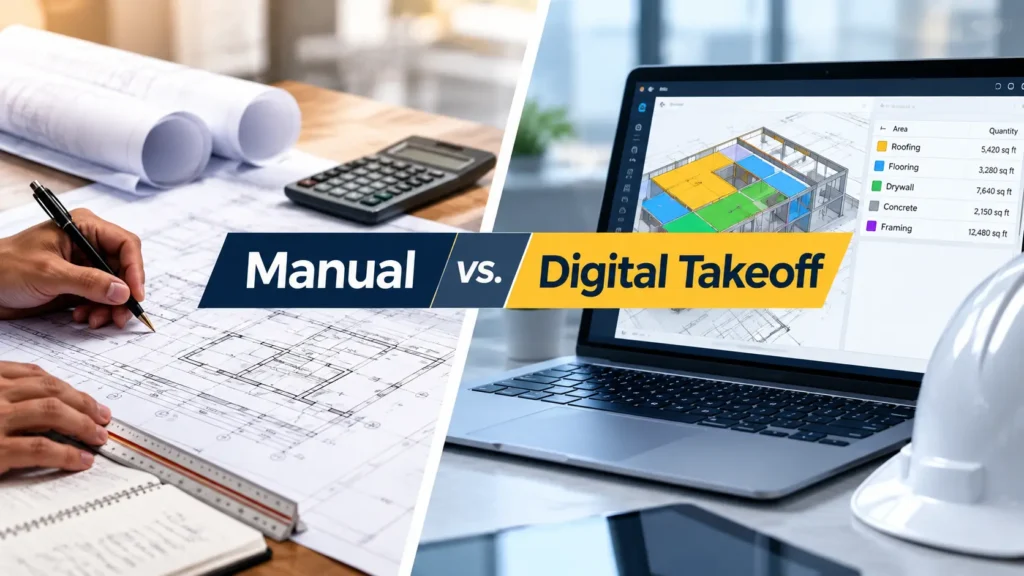
Manual vs. Digital Takeoff: Which Is Actually Right for Your Business?
A manual takeoff means measuring quantities by hand on printed plans using a scale ruler and a calculator. A digital takeoff means measuring the same quantities on screen using specialized software. Neither method is universally better. The right choice depends on your project size, your bid volume and how much your team can afford to spend on tools versus time. Small, single trade jobs often still work fine with a manual takeoff. Larger, multi trade or high volume bidding almost always favors digital.
That is the short answer. The rest of this guide walks through exactly how each method works, where each one wins and how to figure out which approach actually fits your business instead of just following whatever software vendors tell you to buy.
If you are new to the concept entirely, start with our guide on what a construction takeoff actually is before diving into this comparison.
What Is a Manual Takeoff?
A manual takeoff is the traditional way construction professionals calculate material and labor quantities. An estimator prints out the blueprints, then works through them page by page with a scale ruler, a highlighter and a calculator. Every wall length, every square foot of flooring and every fixture count gets measured and recorded by hand, usually onto a paper takeoff sheet or a spreadsheet.
This method has been the backbone of construction estimating for decades and there is a reason it has not disappeared. It forces the estimator to slow down and actually look at every detail on the drawing. Many experienced estimators say that discipline is exactly what makes them good at spotting scope gaps that software sometimes glosses over.
The tradeoff is time. A manual takeoff on a mid sized commercial job can easily eat a full day or more and every revision to the plans means starting that section over by hand.
What Is a Digital Takeoff?
A digital takeoff uses specialized software to measure quantities directly from a digital version of the plans, whether that is a PDF, a CAD file or a BIM model. Instead of a physical ruler, the estimator sets a digital scale, then clicks and traces directly on screen to count fixtures, measure lengths and calculate areas or volumes.
The software handles the math automatically. Once a wall is traced, the tool instantly returns the linear footage. Once a room outline is closed, it returns the square footage. Many platforms also let estimators save templates for repeat work, so a kitchen layout measured once can be reused on the next project with similar specs.
Popular tools in this category include on screen takeoff platforms, PlanSwift style software and PDF markup tools like Bluebeam. The specific software matters less than understanding what digital takeoff actually changes about the workflow, which is speed, consistency and an auditable digital record of every measurement.
Manual vs. Digital Takeoff: Head to Head Comparison
Here is how the two methods actually stack up across the factors that matter most for a construction business.
| Factor | Manual Takeoff | Digital Takeoff |
|---|---|---|
| Speed | Slow. Hours to days depending on project size | Fast. Often cuts takeoff time by more than half |
| Accuracy | Depends heavily on estimator discipline and fatigue | Reduces arithmetic and transcription errors, though scale setup mistakes still happen |
| Cost | No software cost, but high labor cost per bid | Upfront software investment, lower cost per bid over time |
| Scalability | Struggles with high bid volume or complex projects | Built to handle volume and complex, multi trade scopes |
| Revisions | Requires re measuring by hand | Update measurements quickly when plans change |
| Learning curve | Minimal, familiar to most estimators | Requires training time and software familiarity |
| Audit trail | Paper records, harder to verify later | Digital record tied directly to the plan set |
Speed and Turnaround Time
This is where the gap between the two methods is most obvious. A manual takeoff for a straightforward residential job might take two to three hours. A commercial project with multiple trades can take a full day or longer. Digital takeoff tools compress that timeline significantly because the software does the arithmetic instantly and lets an estimator move through sheets faster.
Turnaround time is not just a convenience issue. In competitive bidding, the contractor who submits a complete, accurate bid first often wins the job before slower competitors even finish their numbers.
Accuracy and Error Rate
Manual takeoffs are only as accurate as the person doing them and fatigue is a real factor when an estimator is working through the tenth sheet of drawings late in the day. A single misread dimension or a transposed number in a manual calculation can throw off an entire material order.
Digital takeoff does not eliminate human error entirely. Scale calibration mistakes and misread drawings still happen. But it removes the arithmetic and transcription layer of error, since the software calculates quantities directly from traced measurements. Several industry case studies and vendor audits report error reductions in the range of thirty to fifty percent after teams switch from manual to digital methods, though results vary by team and project type. Separately, recent industry reporting has noted that a meaningful share of construction projects still exceed their original cost estimates due to inaccurate bidding, which underlines why tightening the takeoff process at the front end matters for the whole project budget (source).
Cost: Upfront Investment vs. Long Term Savings
Manual takeoff has no software cost, which makes it attractive for a business just starting out or bidding only occasionally. But the real cost shows up in labor hours. An estimator’s time is not free and hours spent manually measuring quantities are hours not spent on other revenue generating work.
Digital takeoff software requires an upfront investment, whether that is a monthly subscription or a one time license. For a contractor bidding regularly, that cost is usually recovered quickly through faster turnaround and the ability to bid on more projects without adding estimating staff.
Scalability for Growing Bid Volume
A one person operation bidding on a handful of small jobs a year can manage fine with manual takeoffs. But as bid volume grows or as projects become more complex with multiple trades and frequent plan revisions, manual methods start to break down. Re measuring an entire section by hand every time a client sends a revised drawing set is not sustainable once you are juggling several active bids at once.
Digital tools handle plan revisions far more gracefully. Many platforms let an estimator compare drawing versions and quickly identify what changed, rather than re measuring everything from scratch.
When Manual Takeoff Still Makes Sense
Manual takeoff is not obsolete and it is worth being honest about where it still holds up.
- Very small, single trade projects with simple scopes
- Occasional bidders who do not justify a software subscription
- Training new estimators on how to read plans and understand spatial relationships before introducing software
- Situations where digital plans are not available and only printed drawings exist
Even estimators who work primarily in digital tools often say the discipline of manual plan reading is what makes them good at their job in the first place. Software speeds up the math. It does not replace the judgment of someone who understands construction sequencing and scope.
When Digital Takeoff Is the Better Choice
Digital takeoff becomes the clear choice once any of the following applies to your business.
- You are bidding on multiple projects per month and need faster turnaround
- Your projects involve multiple trades with overlapping scopes
- Plan revisions happen frequently and you need to track changes efficiently
- You want a documented, auditable record of every measurement for dispute resolution or change order backup
- Your team is growing and you need a repeatable process that does not depend entirely on one person’s manual speed
The Hybrid Approach: Why Experienced Estimators Use Both
The manual versus digital debate often gets framed as an either or decision, but that is not how most experienced estimating teams actually work. The strongest estimators combine the plan reading discipline of manual methods with the speed and consistency of digital tools.
In practice, this means an estimator still reads the full set of drawings carefully before touching the software, the same way they would with a manual takeoff, to catch scope items that automated detection might miss. Then they use digital tools to handle the measuring and calculating, which removes the tedious arithmetic without removing the human judgment that catches missing details, unusual site conditions or scope gaps between trades.
This hybrid approach is often what separates a takeoff that is technically complete from one that actually protects a contractor’s profit margin on a bid.
How to Decide Which Method Is Right for Your Business
Instead of guessing, run your business through this quick checklist.
- How many bids do you submit per month? One or two occasional bids can work fine manually. Five or more per month usually justifies digital tools.
- How complex are your typical projects? Single trade and small scope favors manual. Multi trade, commercial or large residential favors digital.
- How often do plans get revised mid bid? Frequent revisions make digital tools far more efficient to manage.
- What is your current estimating bottleneck? If turnaround time is costing you bids, digital takeoff addresses that directly.
- Do you have budget for software and training time? If not yet, manual can bridge the gap while you plan the transition.
If you answered mostly toward higher volume, more complexity and frequent revisions, digital takeoff is very likely worth the investment. If your business is smaller and bid volume is low, manual takeoff can still serve you well, at least for now.
Frequently Asked Questions
Q: Is digital takeoff more accurate than manual takeoff?
Digital takeoff generally reduces arithmetic and transcription errors because the software calculates quantities automatically once a measurement is traced. It does not eliminate error entirely, since scale calibration mistakes and misread drawings can still occur, but overall accuracy tends to improve compared to fully manual methods.
Q: How much time does digital takeoff actually save?
The time saved depends on project size and complexity, but many estimating teams report cutting takeoff time significantly, often by half or more, especially on projects with repeat scopes like flooring, framing or fixture counts.
Q: Do small contractors need takeoff software?
Not always. A small contractor bidding occasionally on simple, single trade jobs can often manage well with manual takeoffs. Once bid volume or project complexity increases, digital tools usually pay for themselves through faster turnaround.
Q: Can you combine manual and digital takeoff methods?
Yes, and many experienced estimators do exactly that. They read plans manually to catch scope details and judgment calls, then use digital tools to handle the actual measuring and calculating.
Q: What is the learning curve for digital takeoff software?
Most modern takeoff platforms are designed to be intuitive and estimators who are comfortable reading plans typically adjust within a few projects. The bigger adjustment is usually workflow habits rather than the software itself.
Which Method Fits Your Next Bid?
Choosing between manual and digital takeoff does not have to be a guessing game once you know your bid volume, project complexity and where your current process is slowing you down. If you would rather skip the learning curve entirely, our team at Land Mark Estimations handles both manual and digital takeoffs daily across residential and commercial projects and we can tell you within minutes which approach fits your next bid. Get in touch with our estimating team to see how a properly done takeoff can tighten your numbers and help you win more work.
David Wilson
0