
Trade-Specific Cost Guides
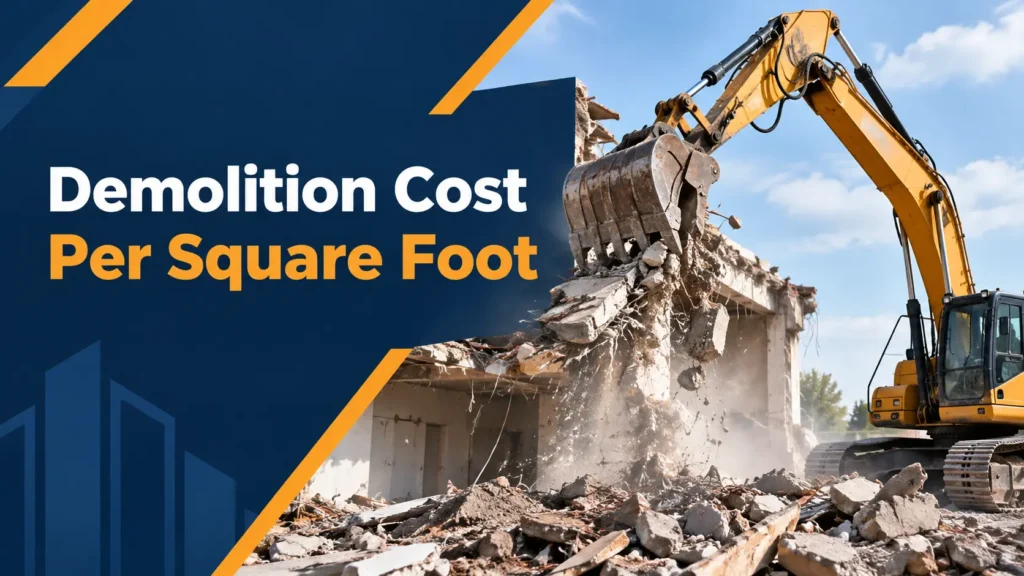
Demolition Cost Per Square Foot: What Drives the Price
Demolition typically costs between $2 and $30 per square foot, depending on whether the project is residential or commercial, full or selective and whether hazardous materials like asbestos are involved. A standard residential teardown runs $4 to $17 per square foot. Interior or selective demolition runs $2 to $8 per square foot. Large commercial demolition can reach $25 to $30 per square foot once size, structure type and disposal costs are factored in.
That range is wide because square footage alone doesn’t set the price. Two buildings of the same size can cost very different amounts to demolish once you account for what the structure is made of, how the site can be accessed and where the debris has to go. This guide breaks down current 2026 pricing by project type, walks through the factors that move the number up or down and explains why a real takeoff beats a flat rate per square foot every time.
Demolition Cost at a Glance
| Project Type | Cost Per Square Foot | Typical Total Cost |
|---|---|---|
| Residential full demolition | $4 to $17 | $6,000 to $25,000 (avg. home) |
| Interior or selective demolition | $2 to $8 | $2,000 to $20,000 |
| Commercial demolition, small building (1,000 to 5,000 sq ft) | $4 to $8 | $20,000 to $40,000 |
| Commercial demolition, large building (20,000+ sq ft) | $18 to $30 | $100,000+ |
| Asbestos abatement (add-on) | $2 to $5 | Varies by square footage tested positive |
These figures reflect national averages. Local labor rates, permit requirements and landfill tipping fees will move your actual number closer to the top or bottom of each range.
Residential Demolition Cost Per Square Foot
Most homeowners and contractors demolishing a single family home should budget $4 to $17 per square foot for a standard mechanical teardown, where an excavator does the bulk of the work. Manual deconstruction, where materials are removed by hand for salvage or recycling, runs significantly higher, often $20 to $30 per square foot, because it trades speed for material recovery.
| Home Size | Estimated Cost Range |
|---|---|
| 1,200 sq ft | $4,800 to $20,400 |
| 1,500 sq ft | $6,000 to $25,500 |
| 2,000 sq ft | $8,000 to $34,000 |
| 3,000 sq ft | $12,000 to $51,000 |
A basement changes this math more than almost any other single factor. Removing a concrete basement and backfilling the hole with clean fill dirt can add several thousand dollars to a project that would otherwise sit at the low end of its size bracket.
Full Demolition vs. Partial Demolition
Full demolition removes the entire structure and typically clears the foundation as well. Partial demolition, such as removing a garage, an addition or a single wing of a house, costs less in total but can run a similar or higher per square foot rate, since fixed costs like mobilization and permitting don’t scale down proportionally with a smaller footprint.
Commercial Demolition Cost Per Square Foot
Commercial demolition costs scale differently than residential. Smaller commercial buildings sit close to the residential range, but per square foot pricing actually climbs as buildings get taller and more complex, the opposite of what many contractors expect.
| Building Size | Cost Per Square Foot |
|---|---|
| 1,000 to 5,000 sq ft | $4 to $8 |
| 5,001 to 10,000 sq ft | $8 to $12 |
| 10,001 to 20,000 sq ft | $12 to $18 |
| 20,001 to 50,000 sq ft | $18 to $25 |
| Over 50,000 sq ft | $25 and up |
Structure type matters as much as size. A wood framed single story retail building is inexpensive to bring down compared to a concrete and structural steel warehouse or a multi story office building, which requires heavier equipment, longer timelines and more careful sequencing to keep the site safe.
Interior and Selective Demolition
Interior demolition, sometimes called selective demolition, is priced separately from full structural teardown because the scope is different: fixtures, partitions, ceilings and flooring come out, but the building envelope stays. This runs $2 to $8 per square foot for both residential and commercial projects, with labor accounting for the largest share of that cost, typically $1 to $5 per square foot depending on access conditions in an occupied or partially occupied building.
What Actually Drives the Price Per Square Foot
Square footage sets the baseline, but five other factors move the final number more than most people expect.
Structure and Materials
Wood framed buildings demolish faster and cheaper than those built with brick, concrete or structural steel. Mixed material structures, such as homes with stone accents or heavy tile roofing, require more specialized equipment and more time on site, both of which raise labor costs per square foot.
Labor and Site Access
Labor typically makes up the largest single line item in a demolition budget, with crew rates commonly falling between $50 and $100 per hour depending on region and project complexity. Tight urban lots, limited street access and multi story buildings all slow down equipment operators and increase the hours billed to the job.
Location and Landfill Tipping Fees
Where the debris goes affects the price as much as where the building stands. According to data compiled by the Environmental Research & Education Foundation, national average landfill tipping fees rose to roughly $62 per ton in 2026, with significant regional variation: the Northeast averages closer to $84 per ton, while the South Central region sits nearer $45. Concrete debris alone can weigh over 4,000 pounds per cubic yard, so a project generating a large volume of concrete will feel regional tipping fee differences directly.
Hazardous Materials and Asbestos
Any structure built before the 1990s should be assumed to contain asbestos until it’s tested. When asbestos is confirmed, abatement adds $2 to $5 per square foot on top of standard demolition pricing and in older buildings with extensive friable material, total project costs can climb as high as $25 per square foot once specialized removal crews, containment and EPA compliant disposal are factored in. Skipping the pre-demolition hazmat survey isn’t a way to save money; it’s a liability that shows up later as a fine or a shutdown.
Permits and Inspections
Most municipalities require a demolition permit, typically ranging from $100 to $500, along with utility disconnect confirmations and, in many cases, a pre-demolition inspection. Public and commercial projects often carry additional agency specific requirements that need to be built into the bid before the crew ever mobilizes.
Why Per Square Foot Pricing Is a Starting Point, Not a Bid
Every range in this guide is useful for early budgeting, but none of them is a substitute for a real takeoff. Per square foot pricing averages together every job a contractor has ever priced, from a clean slab on grade teardown to a hazmat heavy interior gut. Your project is neither of those; it’s a specific building, on a specific lot, with its own access conditions and disposal logistics.
That’s the gap between a rule of thumb and a bid you can actually stand behind. A rule of thumb tells you roughly what a similar project cost somewhere else. A quantity takeoff tells you exactly what your project will cost, because it’s built from your plans: the actual materials being removed, the actual labor hours the access conditions require and the actual disposal fees for your zip code, not a national average.
How Land Mark Estimations Prices a Demolition Takeoff
At Land Mark Estimations, our certified demolition estimators build every estimate from your plans rather than a square footage assumption. That means a full quantity takeoff of materials to be removed, labor hours priced against real access conditions, equipment and hauling costs and disposal and landfill tipping fees calculated using zip code specific data rather than a national range. Whether the scope is interior selective demolition, full structure removal or site clearing tied to concrete and foundation work, estimates are delivered within 24 to 48 hours and formatted to be submission ready, including for public bid projects that require agency specific bid forms.
Frequently Asked Questions
Q: How much does demolition cost per square foot?
Demolition costs $2 to $30 per square foot depending on scope. Residential teardowns run $4 to $17 per square foot, interior or selective demolition runs $2 to $8 and large commercial demolition can reach $25 to $30 per square foot.
Q: Is demolition cost higher if asbestos is found?
Yes. Asbestos abatement typically adds $2 to $5 per square foot on top of standard demolition costs and total project costs can reach $25 per square foot in older buildings with extensive friable asbestos requiring specialized removal.
Q: What’s included in a demolition cost estimate?
A complete demolition estimate includes a quantity takeoff of materials to be removed, labor hours based on scope and access conditions, equipment and hauling costs and disposal or landfill tipping fees based on project location.
Q: Does commercial demolition cost more than residential demolition?
Commercial demolition can cost more per square foot on larger buildings, since taller structures and heavier materials like concrete and structural steel require more equipment and time. Smaller commercial buildings often price similarly to residential teardowns.
Q: How much does interior demolition cost per square foot?
Interior or selective demolition typically costs $2 to $8 per square foot for both residential and commercial projects, with labor making up $1 to $5 per square foot of that range.
Q: Why isn’t a per square foot price enough for a bid?
Per square foot pricing is an average across many past projects and doesn’t account for your building’s specific materials, access conditions or local disposal costs. A quantity takeoff, built from your actual plans, reflects your project’s real cost rather than a national estimate.
Reviewed by David Wilson, Estimator Head at Land Mark Estimations. Our team holds certifications from ASPE and NIBS and has delivered demolition estimates for residential, commercial and public bid projects nationwide with a 99% bid-hit ratio.
David Wilson
0