
Bidding & Business Tips for Contractors
Why Contractors Lose Bids: 10 Reasons and How to Fix Each One
Why Contractors Lose Bids: Contractors lose bids mainly because of inaccurate takeoffs, prices that are too high or too low, missed addenda, incomplete bid packages, missed deadlines, bonding or licensing gaps and proposals that fail to show value. Most of these problems are preventable with a repeatable estimating and bid review process.
Losing a bid hurts because you spent hours on plans, supplier calls and math, and got nothing back. The good news is that most losses trace back to a small set of habits you can change. This guide covers the 10 most common reasons construction bids fail and gives you a specific fix for each one. It supports our main guide on how to write a construction bid, so read that first if you want the full bid building process.
In this guide
- Inaccurate takeoffs and missed scope
- Bidding too high
- Bidding too low
- Wrong overhead, profit and markup math
- Weak labor, material and hidden cost pricing
- Missed addenda and unanswered questions
- Incomplete bid packages and form errors
- Missed bid deadlines
- Bonding, licensing and insurance gaps
- Bidding on the wrong jobs with a weak proposal
1. Inaccurate Takeoffs and Missed Scope
Why it costs you the bid: Every price starts with quantities. If your takeoff counts too little, you lose money after you win. If it counts too much, your price climbs and you lose to a sharper number. Industry writers regularly name inaccurate takeoffs as a major reason contractors lose bids, often caused by manual errors or rushed workflows. A missed scope item is worse because nobody notices it until the project is underway.
The fix:
- Read the full drawing set and specifications before measuring anything. Our guide on how to read construction blueprints for a takeoff walks through this step by step.
- Use a scope checklist by trade so nothing falls between divisions.
- Have a second person review every takeoff. Fresh eyes catch flipped dimensions and forgotten sheets.
- Choose the right method for your volume. Our comparison of manual vs digital takeoff shows where each one fits.
If you are new to the process, start with what a construction takeoff is and how it differs from an estimate in takeoff vs estimate vs bid.
Estimator’s note: The most expensive scope misses are usually at trade boundaries, such as who supplies blocking, firestopping, patching after MEP rough in or temporary protection. Write these items in your inclusions and exclusions so both you and the owner know where your price ends.
2. Bidding Too High
Why it costs you the bid: Owners compare numbers first. When your price sits well above the field, you get screened out before anyone reads your proposal. High prices often come from padded contingency, inflated markups, outdated supplier quotes or a scope that includes work nobody asked for.
How to tell if your bid is too high: Compare your number to recent similar projects in your market, to your own historical cost per square foot and to any unit price data you have. If you are more than about 10% above the range you expected and cannot explain it with scope, schedule or risk, recheck the takeoff and the markup before you submit.
The fix:
- Price from current supplier quotes, not last year’s numbers.
- Break contingency out by risk instead of adding a flat cushion.
- Confirm your pricing method fits the job. Our guide to unit price vs lump sum estimating explains when each approach protects you.
- Track the winning number on every loss you can learn from.
3. Bidding Too Low
Why it costs you the bid: A rock bottom number can look like a win, but it also looks like a warning. Some owners see an extremely low bid as a sign of missing scope or a contractor who will ask for change orders later. Rejection guides report that project owners may view extremely low bids as a red flag. Even when a low bid is accepted, you may finish the job at a loss.
The fix:
- Set a floor price based on your real cost plus overhead and profit, and do not go below it.
- If you are far below the other bidders, stop and search for a missed item before you submit.
- Learn from the spread. If your bid is 20% under second place, you probably left something out.
4. Wrong Overhead, Profit and Markup Math
Why it costs you the bid: Many contractors confuse markup with margin. A 20% markup on a $100 cost gives a $120 price, which is a profit of $20 or 16.7% of the selling price. To earn a true 20% margin you need a 25% markup ($125 price, $25 profit). Get this wrong and you either give away profit or price yourself out of the job. Guides on contractor mistakes call this a common error that costs contractors thousands per job.
The fix:
- Decide whether your target is markup or margin and use one formula everywhere.
- Calculate overhead as a real number: office rent, insurance, vehicles, software, admin wages and estimating time, divided across your annual work.
- Show overhead and profit as separate lines in your internal worksheet, even if the owner only sees a total.
5. Weak Labor, Material and Hidden Cost Pricing
Why it costs you the bid: Pricing errors rarely come from big items. They come from labor hours that assume perfect conditions, material costs that moved since the quote, and small items nobody counted. Fasteners, consumables, dump fees, mobilization and cleanup add up on every project. Material price escalation is another quiet killer on long bid windows.
The fix:
- Use crew productivity from your own past jobs, not generic averages.
- Put an expiry date on supplier quotes and add an escalation clause or allowance when prices are volatile.
- Add contingency deliberately. One contractor resource suggests 5 to 10% for new construction and 10 to 15% for typical remodels and your own risk should adjust that.
- Use trade specific cost guides for reality checks, such as our drywall estimating guide, earthwork and excavation guide and demolition cost per square foot.
Trade examples: Roofing bids lose money on tear off, disposal and decking repairs. Electrical and HVAC bids fail when equipment lead times and wire or duct price swings are ignored. If you need help with any of these, see our roofing estimating services and MEP estimating services.
6. Missed Addenda and Unanswered Questions
Why it costs you the bid: Addenda change scope, quantities, dates and forms. If you price from the original documents only, your number is wrong and on public work your bid may be thrown out. Compliance guidance for federal work explains that a missing bond, an unacknowledged amendment or a late submission carries the same consequence and the bid goes no further.
The fix:
- Check the bidding portal and your email daily until the deadline and again on bid day.
- List every addendum on your bid form and note what changed in your estimate.
- Submit written questions (RFIs) early instead of assuming. Unclear scope should be resolved before pricing, not after award.
7. Incomplete Bid Packages and Form Errors
Why it costs you the bid: Missing signatures, blank fields, wrong forms and absent attachments are among the easiest ways to lose. One rejection guide lists missing documents, expired licenses, pricing errors, lack of bonding, incomplete proposals and late submissions among the most common causes of rejection. In sealed bidding, there is often no chance to fix a mistake after opening.
Bid documents checklist:
- Signed bid form with all unit prices and totals filled in
- Bid bond or bid guarantee, with the correct power of attorney
- Addenda acknowledgment
- License, insurance certificates and references
- Required certifications and forms for the agency
- Schedule, alternates and allowances if requested
The fix: Build one master checklist, assign an owner and do a final review the day before the deadline, not the hour before.
8. Missed Bid Deadlines
Why it costs you the bid: Late is late. Portals lock, sealed bids close and owners rarely make exceptions. Missed deadlines also come from poor organization. Research on public contracting notes that teams without a reliable tracking system often lose contracts simply because deadlines were not clear.
The fix:
- Set your internal deadline 24 hours before the real one.
- Submit early. Upload problems, portal outages and last minute price changes are common.
- Keep one shared calendar for every active bid instead of scattered emails and notes.
9. Bonding, Licensing and Insurance Gaps
Why it costs you the bid: Owners need proof you can finish the work. A missing bid bond, expired license or weak insurance certificate can disqualify you before price is read.
Bid bond requirements in brief: On federal construction, the FAR says the bid guarantee should be at least 20 percent of the bid price and not more than $3 million. See the FAR Part 28 bonds and insurance rules for the official text. State and local rules vary, so read each solicitation.
If you struggle to get bonded: The SBA Surety Bond Guarantee Program exists to help small businesses that cannot get bonds through regular channels. The SBA does not issue the bond itself. As one surety guide explains, it guarantees the bond so qualified small businesses can be approved when they otherwise might not be. Talk to a surety agent early, well before bid day. Your surety and insurance agent should be part of your bidding team.
The fix: Track license renewals and insurance expiry dates and keep updated financials ready for your surety.
10. Bidding on the Wrong Jobs with a Weak Proposal
Why it costs you the bid: Bidding on everything spreads your team thin and lowers quality. Guidance on public contracts warns that bidding outside your strengths or against firms with stronger past performance, leads to a lot of effort and little return. Another source notes that selective, qualified bidding raises your win rate and protects team capacity.
Even on the right job, a bland proposal blends in. When your price is close to others, owners choose based on clarity, experience and confidence. Many owners also begin forming a shortlist before the formal invitation goes out. Contractors with a weak online presence or poorly documented project history can be excluded before they get a chance to compete.
The fix:
- Use a bid or no bid checklist: project type, size, client, competition, bonding, schedule and your capacity.
- Write a proposal that answers what the owner asked for. Public agencies often score against stated criteria and one loss analysis says many firms fail because they write about what they do well instead of proving what the agency asked for.
- Show relevant projects, safety record, key people and schedule approach. Browse how we present work on our projects page.
- Follow up after submission. A short, polite call or email keeps you visible and often reveals how you ranked.
- Build a bid vs qualifications package that shows who you are, not just what you charge.
Subcontractors and small contractors: Speed matters. When each bid takes days, you bid fewer jobs and win fewer. One industry article explains that bidding fewer jobs means winning fewer, which leaves less revenue to invest in better tools. Outsourcing takeoffs can break that cycle. See our subcontractor estimating services and general contractor estimating services. For agency work, our public bid estimating services cover the compliance side too.
What Is a Good Bid Win Rate?
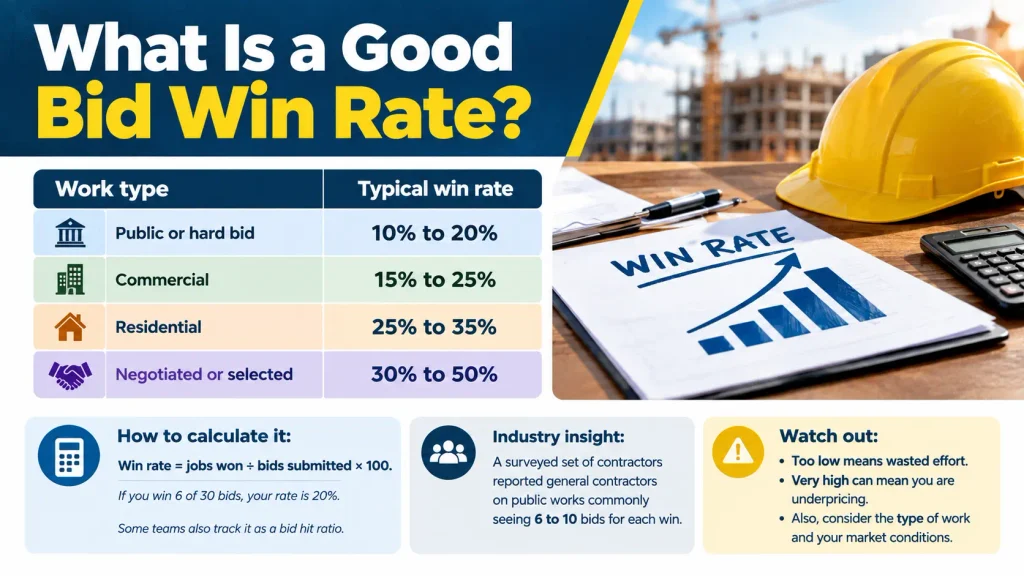
A good bid win rate depends on the type of work. One industry expert states that 10 to 20% is typical for hard bid or public competitive work and 30 to 50% is common for negotiated or selected work. Another benchmark suggests 25 to 35% for residential contractors and 15 to 25% for commercial.
| Work type | Typical win rate |
|---|---|
| Public or hard bid | 10% to 20% |
| Commercial | 15% to 25% |
| Residential | 25% to 35% |
| Negotiated or selected | 30% to 50% |
How to calculate it: Win rate = jobs won ÷ bids submitted × 100. If you win 6 of 30 bids, your rate is 20%. Some teams also track it as a bid hit ratio. A surveyed set of contractors reported general contractors on public works commonly seeing 6 to 10 bids for each win.
Watch out: Too low means wasted effort. Very high can mean you are underpricing. Also remember that the bid/no bid rate measures your selectivity, while win rate measures your competitiveness, so track both.
How to Review a Lost Bid
- Ask for feedback. Yes, you can ask why you lost a bid. Contact the owner or GC politely and ask for the winning range or how your price and proposal compared. Public agencies often offer debriefs.
- Compare the numbers. Line up your bid against the winning bid by trade and division.
- Find the category. Was it price, scope, compliance, qualifications or relationship?
- Log it. Keep a simple sheet with project type, size, competitors, spread and reason.
- Change one process. Add a checklist step, adjust a rate or refine your bid or no bid rule.
Frequently Asked Questions
Q: Why do contractors lose bids?
Most lose because of takeoff errors, pricing that is too high or too low, missed addenda, incomplete paperwork, missed deadlines, bonding or licensing problems and proposals that do not show value.
Q: Why was my bid rejected?
Common causes are missing documents, unsigned forms, an unacknowledged addendum, no bid bond, a late submission or a price the owner considered unrealistic.
Q: Why are construction bids rejected on public projects?
Public work uses strict rules. A bid that does not meet every mandatory requirement is called nonresponsive and can be rejected before price is compared.
Q: How do you know if your bid is too high?
Compare it with recent similar projects, your historical cost data and the number of other bidders. If you are far above the expected range and cannot justify it, review the takeoff, markup and contingency.
Q: What happens if you underbid a contract?
You may win the job but lose money, push for change orders or struggle with quality and cash flow. Some owners also reject bids that look too low to be real.
Q: What is a good bid win rate?
It varies by work type. Public bids are often 10% to 20%, commercial 15% to 25%, residential 25% to 35% and negotiated work 30% to 50%.
Q: How many bids should a contractor win?
There is no single number. Track your own rate by project type and client, then improve it by bidding more selectively and fixing repeat errors.
Q: Can you ask why you lost a bid?
Yes. A short, respectful request often gets useful feedback, especially from repeat clients and public agencies.
Final Thoughts
Contractors lose bids for reasons that are mostly fixable: weak takeoffs, poor pricing math, missed paperwork and unfocused bidding. Fix the process and your win rate follows. If you want a second set of eyes or a faster turnaround on quantities, Land Mark Estimations can help with takeoffs and estimates across trades. Explore our construction estimating services, check the estimating FAQs, download free estimate samples or contact us for a free estimate quote.
Related reading: How to Write a Construction Bid | Bidding & Business Tips for Contractors | Construction Estimating Blog
David Wilson
0